
Fremont City Directory Holdings
Research begins with the documented Fremont collection, not an assumed annual run. Omaha Public Library's city-directory holdings list Fremont microfilm for 1903 through 1936 and a set of printed editions from 1957 through 1993. The library describes these as collection holdings, so a missing year should be treated as a gap rather than filled in by guesswork. Its Genealogy and Local History Room is the key shelf for the microfilm and printed books. Call or ask staff about current access, the proper reel, and reader availability before a visit.
| Fremont collection | Documented years | Holding location | How to use it |
|---|---|---|---|
| Microfilm run | 1903-1936 | Omaha Public Library Genealogy and Local History Room | Ask staff for the relevant reel and reader. |
| Printed editions | 1957; 1960-61; 1963-66; 1968-70; 1972-73; 1975; 1977-80; 1982-83; 1985; 1987; 1989-91; 1993 | Omaha Public Library Genealogy and Local History Room | Use the exact edition and pair gaps with adjacent years. |
| NSGS Fremont volumes | 1961, 1966, 1968, 1985, 1992 | Nebraska State Genealogical Society catalog | Request by call number 978.2235 FRE. |
| Local directory transcription | 1880-81; later coverage claimed with gaps | NEGenWeb Dodge County | Use as a lead, then verify the original scan or holding. |
The collection does not document publisher names for the Fremont runs, and no official source identified a local reverse or criss-cross directory run. A title page, catalog record, or librarian can settle those questions for a particular volume. Note: Keep the edition year, repository, page, and whether the result is a transcript or original with each Fremont volume note.
Fremont City Directory Years and Gaps
The numbers matter because Fremont volumes arrive in distinct blocks. Microfilm spans 1903 to 1936, then the documented printed shelf begins at 1957. Within the printed range, 1958-59, 1962, 1967, 1971, 1974, 1976, 1981, 1984, 1986, 1988, and 1992 are not listed in the documented run. That absence may reflect a collection gap, not proof that no Fremont directory was published or that a household vanished. The Nebraska State Genealogical Society catalog provides a second documented holding for selected editions, including 1992.
NEGenWeb's Dodge County material adds an 1880-81 resident-directory index and claims directory coverage from 1891 onward with some years missing. It is useful for finding a name, but it is a volunteer genealogy aid, not evidence that every claimed edition is digitized or physically available. Verify a promising entry at Keene Memorial Library, Omaha Public Library, NSGS, or an original scan. Fremont's historical record trail also has loss points: county courthouse fires in 1887 and 1915 damaged or scattered public records, which helps explain why a date range can be uneven.
| 1903-1936 | Officially documented Fremont city-directory microfilm. |
|---|---|
| 1957-1993 | Documented printed editions with substantial missing years. |
| 1880-81 | Local genealogy index lead that needs original-source verification. |
| 978.2235 FRE | Nebraska State Genealogical Society catalog call number for selected Fremont volumes. |
Reading a Fremont City Directory Entry
A Fremont entry is compact, but it can tie a name to a place and date. A 1891/92 transcription, for example, lists J. S. Hoy as a cattle dealer at 210 E. Military in Fremont City, Dodge County, Nebraska. The transcription is an example of the fields that can appear, not a substitute for the original page. Occupation is a historical index clue, and a street line can lead to a parcel or newspaper search. Neither proves a present connection.
| Name | Surname, given name, initials, and sometimes a suffix or alternate spelling. |
|---|---|
| Household clue | A spouse or second adult may appear in parentheses; a widow notation may appear in some editions. |
| Occupation or business | A dated work or business clue that can help distinguish people with the same name. |
| Residence or business address | Street and number, which should be compared with the edition's abbreviations and nearby years. |
| Edition context | Title page, page number, abbreviation key, and original-versus-transcript status. |
- Householder index
- A name-led arrangement that helps locate an adult or listed household in a given edition.
- Criss-cross directory
- An address-led directory. No exact Fremont run was verified, so ask a repository before expecting one.
- Abbreviation key
- The edition's own explanation of shortened words and marks. Photograph or transcribe it before expanding an entry.
Do not assume that each Fremont edition uses the same marks or order. The original scan or library volume supplies the only reliable key for that entry.
Tracing a Fremont City Directory Household
Use a Fremont volume as a dated household lead. Start near the event you know, then work outward through the nearest available editions. An occupation may change while the same household remains at the address. Conversely, a familiar name at a new address may be another person. Compare several facts before linking entries, especially initials, spouse notation, street, neighbors, and the local time frame.
- Find the closest available Fremont edition and record the full entry, exact address, occupation, spouse notation, and any abbreviations.
- Check the available edition before and after it. Mark a gap as a gap rather than inventing an annual sequence.
- Pair the 1903-1936 microfilm years with the 1910, 1920, and 1930 federal censuses. Pair later volumes with released 1940 and 1950 census material.
- Use a Tribune notice, obituary, marriage notice, yearbook, cemetery clue, or deed as a separate check on the household trail.
- For an address that needs current parcel evidence, use the Fremont street directory route rather than treating a historical directory line as a modern occupancy record.
Census schedules add relationships and ages that a Fremont volume may omit. Directories add street addresses and occupations between census dates. Deeds and assessor cards identify property relationships, but do not show every person who lived at a parcel.
Fremont City Directory Clues in Nebraska Memories
The Keene Memorial Library and Dodge County Historical Society Nebraska Memories collection offers more than fifty digitized Fremont images of businesses, churches, schools, residences, architecture, and street scenes from the late nineteenth and early twentieth centuries.
Captions can connect a Fremont surname to a house, business, or street scene that appears near the same period in a volume. Check the collection's rights statement before reusing an image, and compare captions with a dated directory entry rather than assuming a subject stayed at that address.
Browse the Buildings, Business, Houses, Interiors, and Street Scenes groupings when a Fremont address or business name appears in a volume. These are visual and descriptive leads, not a replacement for the page in the directory or a county record.
Fremont City Directory Research Desks
Omaha Public Library's documented Fremont directory shelf is the strongest source for the exact microfilm and print years. Keene Memorial Library at 1030 N Broad provides research help, Book-a-Librarian access, Tribune microfilm, and obituary or genealogy request support. A 2021 library-board packet says its Tribune microfilm runs from 1868 through June 2013, with staff help on the reader and printer. Historic request pricing in older material should be confirmed before use.
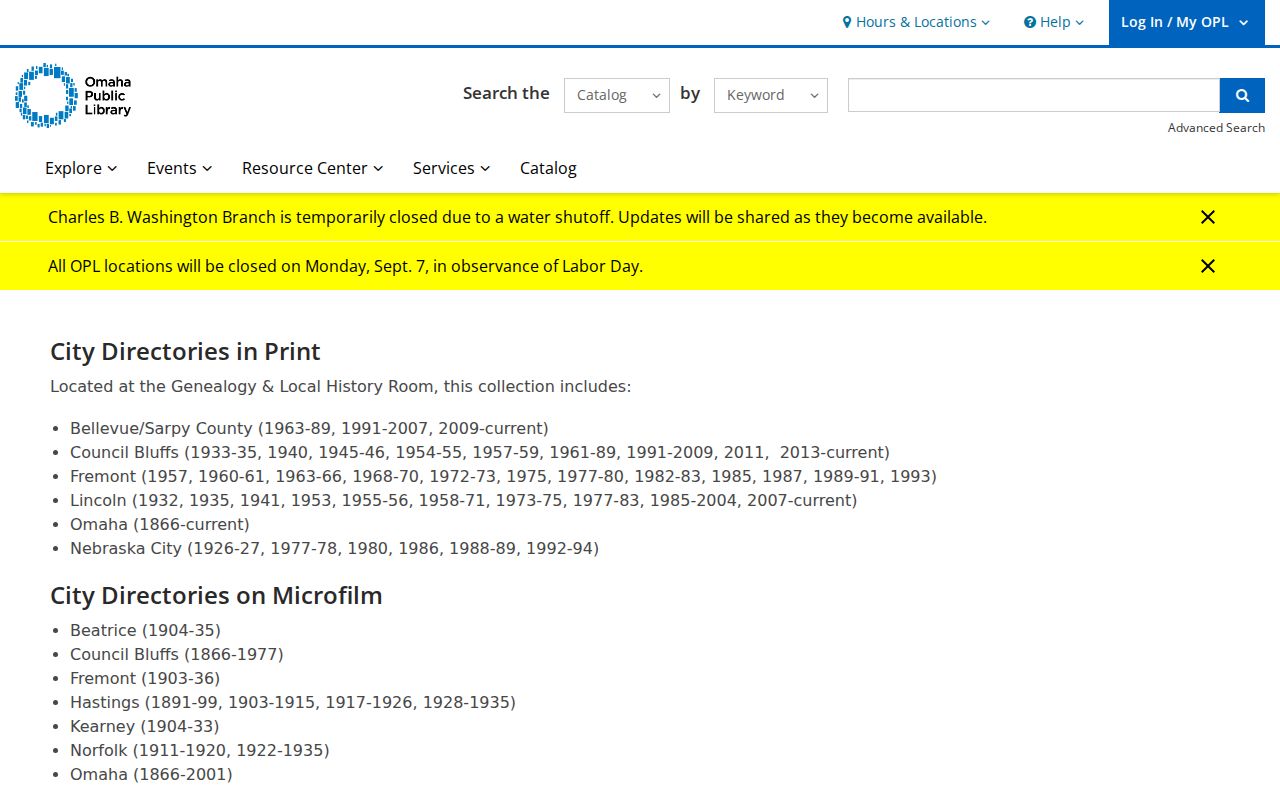
The library holdings view is a useful starting point for selecting an exact Fremont edition, but it does not make the gaps disappear. Ask staff whether a volume is in print, microfilm, or another access format before relying on a trip or request.
The Dodge County Historical Society and Louis E. May Museum maintains a research library and request service for local histories, photographs, society files, and property or community context. The museum publishes Wednesday-Saturday tours from 10:00 to 3:30, with lunch from 12:30 to 1:30, and office hours Tuesday-Saturday from 9:00 to 5:00. Its published research contact is 402-721-4515, and visits are by freewill donation. Nebraska State Genealogical Society contributes its cataloged Fremont volumes, while History Nebraska can help with county records, atlases, plats, and broader repository guidance.
The May Museum image represents the local-history request channel that complements the public-library shelf. A precise question with a surname, address, date range, and collection type is more likely to reach the right Fremont material.
Fremont City Directory Companion Records
When a Fremont volume has no entry, shift to sources that preserve a different kind of trace. Keene's historical request materials point to the Cemetery Index, Tribune microfilm, Obituary Index, and Roots and Leaves. Local genealogy listings identify Fremont High School yearbooks from 1907 to 1976 and Midland College yearbooks from 1920 to 1975, each with some gaps. FamilySearch supplies a Nebraska marriage index for 1855-1995 and a digitized Dodge and Washington county history, both useful for discovery before an official record request.
NEGenWeb includes census, land, tax, naturalization, obituary, voter-registration, and directory transcriptions for Dodge County. Treat these as pointers. The original record, image, repository description, or custodian remains the better proof. For older county books, the History Nebraska RG266 finding aid records surviving and missing series after the 1887 and 1915 courthouse fires. Note: A missing Fremont directory entry can mean a gap, an abbreviation, a spelling issue, a different household arrangement, or an unlisted person.
Fremont Directory History and Record Gaps
Fremont's directory shelf sits beside a damaged county record history. A courthouse fire on December 31, 1887 destroyed many early books and required transcripts, and another major fire on December 5, 1915 destroyed substantial records. County government worked from the First National Bank building until the new courthouse was dedicated in 1918. Printed volumes and newspapers can therefore supply a needed location clue when a county series is reconstructed, missing, or held elsewhere.
- 1887: The first courthouse fire destroyed many early books and led to reconstructed court records.
- 1915-1918: A second fire displaced county government until the new courthouse was dedicated.
- 1903-1993: The documented Fremont directory evidence consists of 1903-1936 microfilm and selected printed editions from 1957 through 1993.
That history is a reason to record uncertainty, not to force a match. The documented Fremont city-directory evidence begins with 1903-1936 microfilm and resumes in selected printed years from 1957 through 1993. Earlier and later claims need a cited original. For modern confirmation after a historical discovery, a Fremont resident lookup should use the relevant current custodian and its access limits.